
Lifecycle states at a glance
The API reference labels only EA, Deprecated, and Closed operations. If an operation has no lifecycle label, it is GA.
Early Availability (EA)
Early Availability (EA) operations are new capabilities that Fireblocks makes available to selected workspaces before general release. EA is early access, so an EA operation can change or be removed in any release until it reaches GA.- Access is per workspace. Ask your Customer Success Manager (CSM) to enable an EA operation for your workspace.
- There is no stability commitment. Request and response schemas, behavior, and availability can change without a deprecation period. In the SDKs, a breaking change to an EA operation does not bump the major version. See Versioning and the SDKs.
- Calls without access fail with
403 Forbiddenand error code9027(ENDPOINT_ACCESS_NOT_ENABLED). - An EA operation that is not promoted to GA can close without a deprecation period.
ea and the GA state appears as ga.
General Availability (GA)
General Availability (GA) operations are available to all workspaces and are stable for production use. Fireblocks makes breaking changes to a GA operation only when necessary, and always flags them as breaking in the changelog. A GA operation that Fireblocks needs to remove moves to Deprecated first. See What counts as a breaking change for the definition.Deprecated
A Deprecated operation still works for all workspaces, but Fireblocks plans to close it.- Advance notice. Fireblocks publishes the planned close date before a Deprecated operation closes. The date is in the
Sunsetresponse header and in thesunset_atfield of the OpenAPI spec. - Stability. The same commitment as GA applies until the operation closes.
- Signals. A Deprecated operation carries a label in the API reference, an entry in the changelog, the
x-lifecycleextension in the OpenAPI spec, theDeprecation,Sunset, andLinkresponse headers, and an SDK warning. To learn about a deprecation from your own integration, log the response headers and alert on them. See Find the lifecycle state of an operation.
Closed
A Closed operation returns410 Gone with an RFC 9457 problem details body and error code 9028 (ENDPOINT_CLOSED). Fireblocks guarantees the 410 Gone response for 90 days after closing. After 90 days, a call to the operation can return 404 Not Found instead. Closed is the final state. Fireblocks records the closure of a Deprecated operation in the changelog.
- Reference page. For 90 days after closing, the operation’s page stays in the API reference with a Closed label. After 90 days, Fireblocks removes the page from the API reference.
- OpenAPI spec. Fireblocks removes the operation from the public OpenAPI spec when it closes.
- SDKs. SDK releases after an operation closes no longer include its method. In earlier SDK versions the method still exists, and for 90 days after closing a call to it returns
410 Gone, as a direct API call does, with no SDK warning. - Support. Fireblocks provides technical support for an operation while it is Deprecated. Once the operation is Closed, Fireblocks provides no support for it.
From EA to GA
An EA operation graduates to GA without a change to your code. The operation keeps the same name and call site, and the lifecycle state in the API reference, the response headers, and the OpenAPI spec changes fromea to ga.
SDK versions before v37.0.0 expose some EA operations through a client whose name ends in Beta, for example TempoBetaApi. From v37.0.0 these clients no longer carry the suffix, so upgrading from an earlier version needs a one-time rename of the client, and the operation names and parameters stay the same.
Find the lifecycle state of an operation
Fireblocks exposes an operation’s lifecycle state in four places: the API reference, the response headers, the OpenAPI spec, and the SDK warning log.API reference
The API reference shows a lifecycle chip for every operation that is EA, Deprecated, or Closed. The chip appears in two places: next to the operation in the sidebar and above the description at the top of the operation’s page. A GA operation has no chip.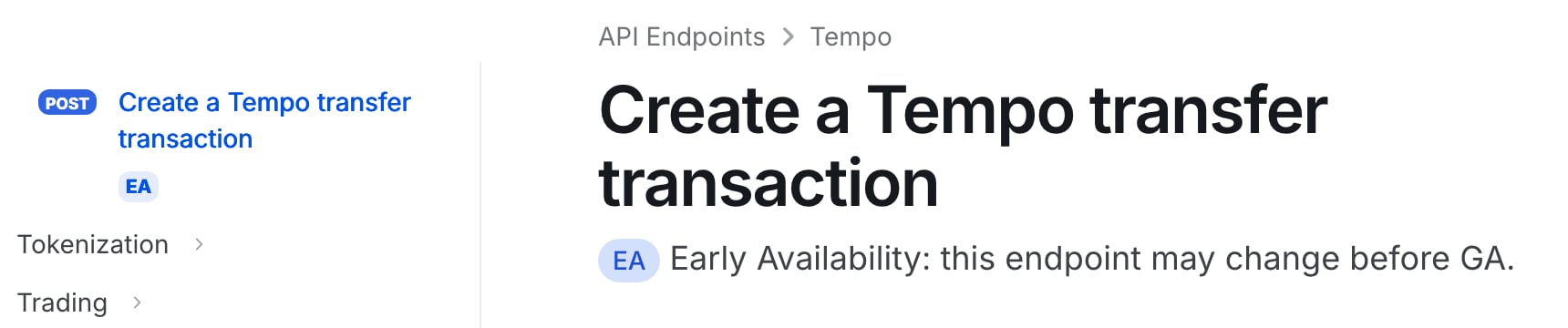
An EA operation. The EA chip appears in the sidebar and at the top of the page.
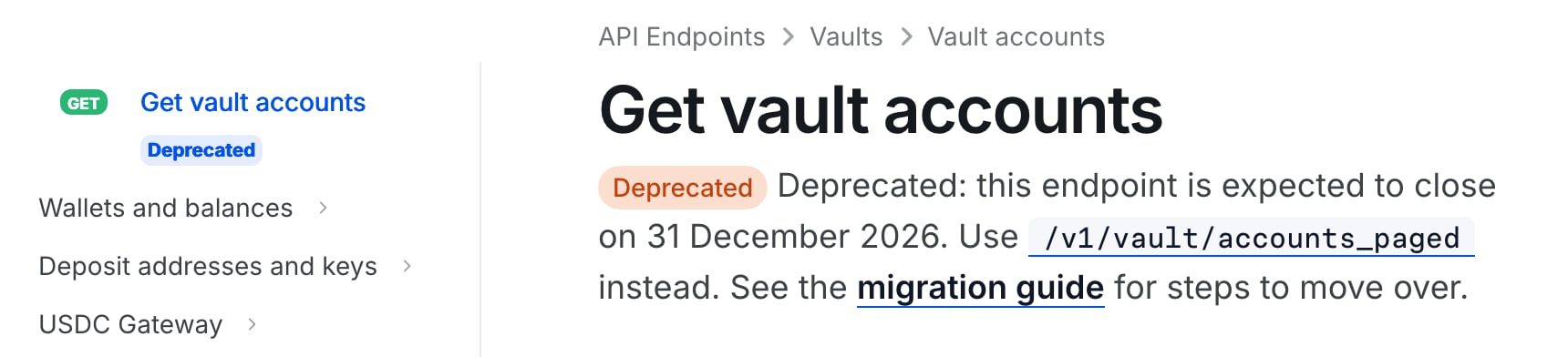
A Deprecated operation. The page shows the expected close date, the replacement operation, and the migration guide.
x-lifecycle extension, described in OpenAPI spec. The note shows only the details that Fireblocks has published for that operation, so a Deprecated operation without a published replacement or migration guide shows the close date alone.
Response headers
An operation that declares a lifecycle state returns these headers.
The following example shows the headers on a response from a Deprecated operation.
OpenAPI spec
The public OpenAPI spec carries anx-lifecycle extension on each operation that declares a state.
stateisea,ga, ordeprecated.deprecated_atandsunset_atare RFC 3339 timestamps in UTC with a trailingZ.replacement_endpoint(optional) is the operation to use instead of the deprecated one. It’s a path relative to the API base URL.migration_guide(optional) is a URL to a guide that explains how to move from the deprecated operation to the replacement.
deprecated_at and sunset_at. The other two fields are optional, so check that they exist and are not null before you read them.
SDK warnings
The Python, TypeScript, and Java SDKs log a warning when a response comes from an operation that is EA, Deprecated, or Closed. The warning is available from SDK version 36.0.0. The SDKs read theFireblocks-Lifecycle-State response header to decide whether to warn.
For example, a Deprecated operation produces a warning like this one.
console.warn. The Python SDK logs it on the fireblocks.lifecycle logger and the Java SDK on the com.fireblocks.sdk.lifecycle logger, so you can adjust their log levels without changing other SDK logging.
To turn the warnings off, set the FIREBLOCKS_SDK_SUPPRESS_LIFECYCLE_WARNING environment variable to any value other than 0 or false.
Versioning and the SDKs
The Fireblocks REST API is versioned by path, for example/v1, and within a version Fireblocks manages change for each operation through its lifecycle state.
SDK versions follow semantic versioning in the form MAJOR.MINOR.PATCH.
- Major versions have incompatible, breaking changes.
- Minor versions add backward compatible functionality.
- Patch versions make backward compatible bug fixes.
What counts as a breaking change
A breaking change to a GA operation is a change that can make a correctly written client stop working. Fireblocks makes these changes only when necessary, and flags each one as breaking in the changelog.Requests
- Removing an operation, a parameter, or an accepted enum value.
- Adding a required parameter.
- Tightening validation on an existing parameter.
- Changing authentication or permission requirements.
Responses
- Removing or renaming a field.
- Changing a field’s type or format.
- Making a field nullable.
- Changing a status code or an error code.
SDKs
- Renaming a method or a model.
- Changing a method signature.
- Raising the minimum supported language version.
Lifecycle changes in the changelog
The changelog announces when an operation becomes EA, GA, or Deprecated, and when a Deprecated operation closes.- Each entry shows the state at publish time. An entry’s lifecycle chip shows the operation’s state when the entry was published. The chip does not change when the operation later moves to another state.
- Each state change gets its own entry. For example, when an operation moves from EA to GA, a new entry announces the change. The operation’s page in the API reference shows its current state.