
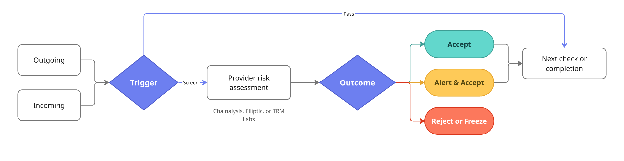
Providers
AML/KYT is a premium add-on: Fireblocks Support enables it on your workspace, and you connect your provider in the Console. Each provider has its own guide that covers what it sends and returns, its timeouts, and the assets it supports.
Only one AML/KYT provider can be connected to a workspace at a time, but different workspaces can use different providers. Connecting and disconnecting are not available through the API: to switch or disconnect, contact Fireblocks Support.
To pause transactions for your own review, regardless of the review process or provider, see Bring Your Own Screening.
Working with AML/KYT through the API
Limitations
- Coverage varies by provider. Which blockchains and assets a provider can screen depends on that provider’s data coverage, not on Fireblocks.
- Some routes are not screened: vault account to vault account, vault account to exchange, Gas Station to vault account, and non-custodial wallet to non-custodial wallet within the same workspace. Outgoing transactions on these routes still go through your provider’s registration flow, so they can count toward your usage quota. To avoid this, add a Pass rule for them.