
- Through a Travel Rule provider, for most counterparties: Notabene, Sumsub, or GTR screens your transactions and exchanges the data with the counterparty VASP. TRUST, a separate network, lets you prove that you own your addresses.
- Directly, for connected accounts: for exchanges and on/off-ramps, Fireblocks passes the required data to the venue, which applies its own requirements. These transactions do not go through a provider or your Travel Rule policy.
How screening works with a provider
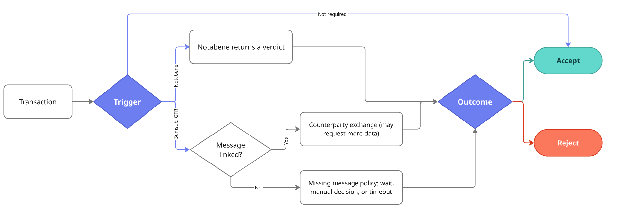
Travel Rule is the last check in the screening flow, after Address Registry Screening and AML/KYT. If AML/KYT freezes an incoming transaction, Travel Rule screening does not run.- The Trigger (Screening Policy) decides whether the transaction needs Travel Rule screening.
- Your provider exchanges the required data with the counterparty VASP.
- For Sumsub and GTR, the Missing Travel Rule Message Policy decides what happens while a required message does not exist yet.
- The Outcome (Post-Screening Policy) acts on the message status: completed, pending, rejected, or failed to complete in time.
Providers
You can connect one Travel Rule screening provider (Notabene, Sumsub, or GTR) per workspace, with one exception: Sumsub and GTR can be active in the same workspace. TRUST is separate and works alongside any of them.
With Notabene, Sumsub, and GTR, you encrypt the PII on your side, so Fireblocks never holds the keys to decrypt it. Each provider guide covers its encryption method and its endpoints.
Connected accounts
- Exchanges: sending encrypted PII with exchange deposits and withdrawals.
- Exchange Travel Rule Requirements: the
piiDatafields each exchange requires, by direction, relationship, and jurisdiction. - On/Off-Ramps: providing originator and beneficiary information on Trading API on/off-ramp orders.