
Where screening runs in a transaction
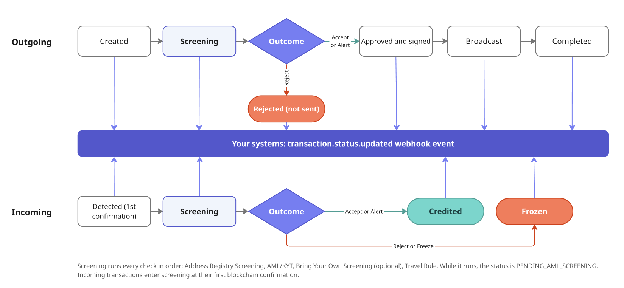
If AML/KYT freezes an incoming transaction, the checks after it do not run.
How this section is organized
If you are new to Identity & Compliance through the API, start with Get started, then read the Key concepts, beginning with Compliance Events & Webhooks. Compliance screening covers everything that happens during a live transaction.- Get started
- What You Can Connect: which checks and providers are available, how each is enabled, and which workspace types support it.
- Key concepts
- Compliance Events & Webhooks: how screening outcomes reach your systems, so you can automate your own flows on top of them.
- Compliance Policies: how Trigger and Outcome rules decide what happens to a transaction, and what you can read and configure through the API.
- Transaction Screening Operations: what you can do with one transaction after it is screened, for example, bypass a rejection or unfreeze funds.
- Customer Reference ID: how to tag transactions with your own customer identifier, so screening results are attributed to the right customer.
- Checks
- Address Registry Screening: confirm whether a counterparty is a verified entity in Fireblocks’ shared Address Registry.
- AML/KYT: screen for blockchain risk through Chainalysis, Elliptic, or TRM Labs.
- Travel Rule: exchange required originator and beneficiary information.
- Bring Your Own Screening: pause a transaction for your own verdict, based on whatever review process or provider you choose.
- Address Registry: look up the legal entity behind an address, register your legal entity, and manage participation.
- Cyber and Operational Resilience (COR) Compliance Package: the legal, reporting, and audit materials that help you manage Fireblocks as a third-party ICT provider under the EU’s Digital Operational Resilience Act (DORA). Help Center only.
- Fireblocks’ Compliance Policy (OFAC Sanctions): Fireblocks automatically blocks outgoing transactions to addresses on OFAC’s sanctions list, before your own policy rules run. A blocked transaction returns
statusBLOCKEDwithsubStatusBLOCKED_BY_POLICY. There is nothing to configure.